
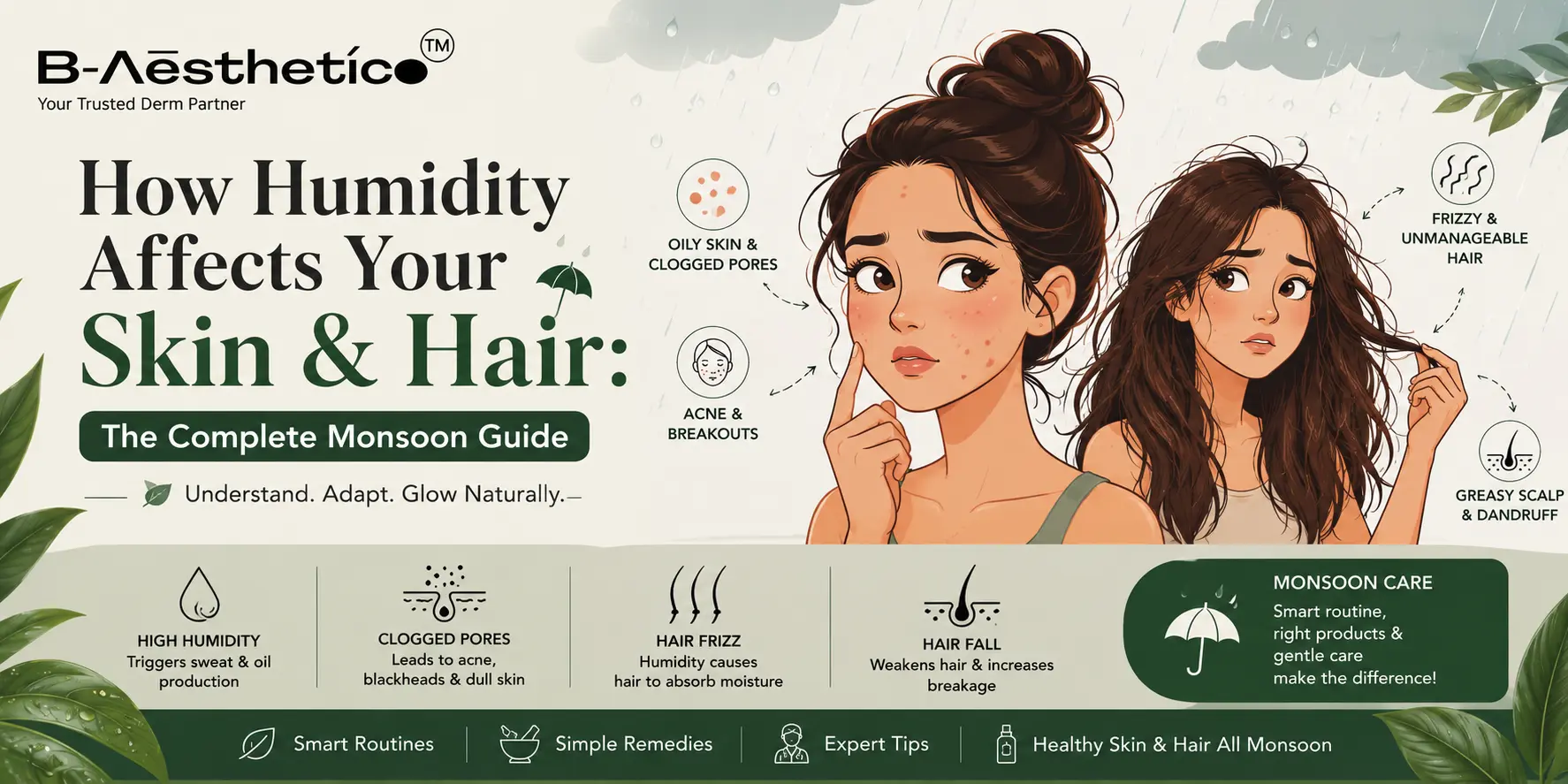
The answer often begins with one environmental factor: humidity.
The monsoon brings cooler temperatures and much-needed rain, but it also brings higher humidity, sweating and prolonged dampness. These conditions can influence how your skin behaves, how quickly your scalp becomes oily, how easily hair becomes frizzy and how comfortable your everyday skincare and haircare routine feels.
Humidity does not automatically "cause" every monsoon skin or hair problem. However, high humidity combined with heat, sweat, sebum, product buildup and environmental exposure can lead to problems such as oily skin, clogged pores, acne flare-ups, scalp buildup, frizz and other common seasonal concerns. Research from Delhi has also found an association between temperature/humidity and seasonal acne aggravation. (PubMed)
So, should you completely change your skincare and haircare routine during monsoon?
Not necessarily.
Instead, your goal should be to understand what humidity is doing to your skin and hair, then make small, sensible adjustments.
In this guide, our experts at B-Aesthetico will explain how humidity affects your skin, hair and scalp, how to build a humid-weather routine, common monsoon mistakes, simple home remedies, and answers to the questions people ask most about monsoon skincare and haircare.
Quick Answer: How Does Humidity Affect Your Skin and Hair?
High humidity can make skin feel oilier and sweatier because moisture in the air slows sweat evaporation. When sweat mixes with sebum, sunscreen, makeup or other residue, skin may feel more congested. Humidity can also affect the hair fibre, making frizz and loss of hairstyle definition more noticeable.
For most people, the best humid-weather strategy is not a complex routine. It is:
- Gentle but effective cleansing
- Lightweight hydration suited to your skin type
- Daily sunscreen
- Regular scalp cleansing based on your scalp's needs
- Gentle handling of wet hair
- Frizz management without excessive heat or product buildup
- Keeping wet or sweaty skin and hair from staying damp for unnecessarily long periods
What Is Humidity?
Humidity is the amount of water vapour present in the air.
When humidity is high, the atmosphere contains more moisture. One important consequence is that sweat evaporates more slowly.
That is why a humid day can make you feel much hotter and stickier than a dry day at the same temperature.
For your skin and hair, this environmental change matters.
Your skin is constantly interacting with its surroundings, while hair can absorb moisture from the atmosphere. As humidity increases, the behaviour of both can change.
But here's a misconception worth clearing up:
Does humid air automatically mean your skin is hydrated?
No.
Humidity and skin hydration are related, but they are not the same thing.
You can have sweaty, shiny skin while still needing appropriate moisturization. Conversely, applying very rich products simply because you feel your skin is "dry" can make oily or combination skin feel unnecessarily heavy.
That is why the right routine depends on your skin type, skin condition, product texture and environment, and not just humidity alone.
For more on how changing weather can affect your skin, see B-Aesthetico's guide: When the Weather Won't Decide: Why Your Skin Suffers.
How Does Humidity Affect Your Skin?
1. Why Does My Skin Get Oily in Humid Weather?
One of the first things many people notice during monsoon is increased shine.
High humidity slows sweat evaporation. As sweat remains on the skin for longer, the face can feel sticky and greasy. Sebum, sunscreen and skincare products can add to that surface feeling.
If you already have oily or combination skin, the effect may be particularly noticeable.
However, skin looking shinier does not always mean that your sebaceous glands suddenly started producing dramatically more oil. Environmental moisture, sweat and sebum together can change how the skin looks and feels.
What should you do?
Avoid trying to remove every trace of oil with harsh cleansers.
Instead:
- Cleanse appropriately for your skin type.
- Use lightweight skincare textures when they feel more comfortable.
- Avoid unnecessary layers of heavy products.
- Keep sweaty skin clean rather than repeatedly scrubbing it.
- Continue moisturizing according to your skin's needs.
A gentle cleanser can be particularly useful as part of a humid-weather routine. B-Aesthetico's Creamy Cleansercan be incorporated into a cleansing routine where its texture and formulation suit your skin.
Can Humidity Cause Acne?
Humidity by itself is not the sole cause of acne, but hot and humid conditions can contribute to an environment in which acne-prone skin experiences more flare-ups.
Sweating, sebum, sunscreen, makeup, pollution and product residue can accumulate on the skin. When combined with existing acne-prone tendencies, this can contribute to congestion.
Research examining acne seasonality in Delhi found that temperature and humidity played a contributing role in acne flares, with aggravation observed particularly during hotter and more humid periods. (PubMed)
If your acne gets worse during monsoon:
Keep your routine simple.
Morning
- Gentle cleansing
- Suitable hydrating product or moisturizer
- Sunscreen
Evening
- Thorough cleansing
- Targeted skincare appropriate for your concern
- Moisturizer when needed
Avoid adding multiple new exfoliants, acids or active ingredients simply because your skin has become oilier.
Consistency usually matters more than complexity.
For readers dealing specifically with changing skin behaviour throughout the year, you can also explore When the Weather Won't Decide: Why Your Skin Suffers.
Does Humidity Make Pores Bigger?
You may notice pores appearing more prominent when your skin is oily or sweaty.
Humidity does not permanently enlarge your pores. However, increased oil, sweat and congestion can make pores appear more visible.
This is another reason to focus on consistent cleansing and appropriate skincare instead of trying to "close" your pores with harsh treatments.
Should You Moisturize Your Skin in Humid Weather?
Yes, but choose the texture according to your skin.
This is one of the most common monsoon skincare questions.
Oily skin still needs appropriate hydration. The trick is finding a formulation that feels comfortable instead of assuming that all moisturizers will feel too heavy.
A person with oily skin may prefer a lighter texture, while someone with dry or barrier-compromised skin may still benefit from a more nourishing cream.
B-Aesthetico's Derma Defender Serumis positioned on the product page as a hydrating, skin-protecting and skin-repairing serum and can be considered according to individual skin needs.
The key principle is simple:
Don't skip hydration simply because the weather is humid. Adjust the texture instead.
How Does Humidity Affect Different Skin Types?
Oily Skin
You may notice:
- More shine
- More sweating
- A heavier feeling on the skin
- Increased congestion
- More frequent breakouts
Keep your routine simple, cleanse appropriately and avoid unnecessarily heavy layers.
Dry Skin
Humid air may temporarily make dry skin feel more comfortable, but it does not replace a proper moisturizer.
Continue supporting your skin barrier according to what your skin needs.
Combination Skin
You may experience an oily T-zone while your cheeks remain comfortable or dry.
Instead of applying exactly the same amount of every product everywhere, pay attention to the different needs of different areas.
Sensitive Skin
Heat, sweat, friction and frequent cleansing may make sensitive skin feel more irritated.
Keep your routine predictable and introduce new products gradually.
Can Humidity Cause Pigmentation or Make Dark Spots Worse?
Humidity is not, by itself, a direct cause of pigmentation.
However, monsoon does notmean you can ignore UV protection.
Cloudy weather can create a false sense of security, while outdoor UV exposure can continue. Sun protection remains an important part of managing pigmentation and preventing further UV-related skin damage.
For a deeper look at why pigmentation develops and the different factors involved, read B-Aesthetico's Pigmentation: Causes, Effects on Skin & Best Treatment for Clear Skin.
Why Should You Still Wear Sunscreen During Monsoon?
Because rainy weather does not mean UV exposure disappears.
Cloud cover can reduce some incoming sunlight, but it does not eliminate ultraviolet radiation.
A broad-spectrum sunscreen should remain part of your daytime routine, particularly when you are outdoors.
B-Aesthetico's Skin Saver SPF 50+++is listed by the brand as a broad-spectrum sunscreen designed to protect against UVA and UVB rays. The product page recommends applying it before going outdoors and reapplying during prolonged sun exposure.
For someone who prefers a combined skincare step, B-Aesthetico also offers a Moisturizer with SPF 30.
The right choice depends on your skin type, routine and amount of sun exposure.
How Does Humidity Affect Your Hair?
If your skin becomes oily during monsoon, your hair may become equally unpredictable.
High humidity can cause hair to absorb moisture from the surrounding environment. This can influence the structure and behaviour of the hair fibre, particularly in wavy, curly, porous or chemically treated hair.
The result can be:
- Frizz
- Flyaways
- Puffiness
- Loss of definition
- Limp roots
- A hairstyle that refuses to stay in place
A 2026 Apollo Hospitals guide similarly notes that humid weather can contribute to swelling of the hair shaft and increased frizz and breakage. (Apollo Hospitals)
Why Does Hair Become Frizzy in Humidity?
Humidity increases the amount of moisture surrounding your hair, and hair responds to changes in environmental moisture.
When individual strands absorb moisture, their shape can change. Strands that normally lie together may become less uniform, producing the familiar "puffy" or frizzy appearance.
This is particularly noticeable if your hair is naturally wavy or curly.
That is why your hair can look perfectly styled indoors and suddenly become much more frizzy after walking outside.
And no, your hair isn't "being difficult."
Humidity really can change how your hair behaves.
Does Humidity Cause Hair Fall?
This needs a little nuance.
Humidity itself should not be blamed for every case of increased hair shedding.
During monsoon, several things can happen at the same time:
- More sweating
- A greasier scalp
- More frequent washing
- Damp hair
- Friction and tangling
- Scalp flaking or irritation
- Breakage from rough handling
These can make hair shedding or breakage seem more noticeable.
Persistent or substantial hair loss can also have causes unrelated to the weather, so "monsoon hair fall" should not become a catch-all explanation for every episode of shedding.
For practical rainy-season hair habits, read B-Aesthetico's Top 10 Monsoon Hair Care Tips.
Does Humidity Cause Dandruff?
Humidity itself does not automatically cause dandruff.
However, warm, humid conditions, sweating, scalp oil and prolonged dampness can worsen some scalp problems in susceptible people.
A warm, moist environment may also support the growth of microorganisms associated with certain scalp conditions. Persistent itching, redness, greasy scaling or painful bumps should not automatically be dismissed as ordinary dandruff.
For a deeper understanding of the scalp and why scalp care deserves its own routine, read B-Aesthetico's Skincare Doesn't Stop at Your Hairline: The Ultimate Guide to Scalp Care.
The Best Skincare Routine for Humid Weather
You do not need a complicated 10-step routine.
A practical humid-weather routine can be much simpler.
Morning Routine
Step 1: Cleanse
Wash away overnight sweat, sebum and buildup with a cleanser appropriate for your skin.
Step 2: Hydrate
Use a suitable serum or moisturizer depending on your skin type and concerns.
Step 3: Sunscreen
Apply broad-spectrum sunscreen generously to exposed skin.
If you are outdoors for prolonged periods, reapply according to the product directions and your exposure.
Optional: Targeted Treatments
If pigmentation, dullness or another concern is part of your routine, use your targeted product according to its directions.
For example, B-Aesthetico's Active Serumcan be linked here as a targeted product option where it is appropriate for the reader's concern.
Evening Skincare Routine for Humid Weather
Step 1: Cleanse
Remove sunscreen, makeup, sweat and daily buildup.
Step 2: Treat
Apply your targeted skincare product according to your skin concern.
Step 3: Moisturize
Use a suitable moisturizer to support comfortable, hydrated skin.
B-Aesthetico's Cell Repairing Creamcan be linked here for readers looking for a richer cream-based skincare option.
Don't automatically use every product every day.
A good routine is one that makes sense for your skin and that you can maintain consistently.
The Best Haircare Routine for Humid Weather
1. Keep Your Scalp Clean
If you sweat heavily or your scalp becomes oily quickly, adjust your washing routine accordingly.
There is no universal "correct" number of hair washes per week.
Your scalp's needs should determine your routine.
2. Don't Keep Wet Hair Tied Up
Wet hair is more vulnerable to mechanical damage.
Allow it to dry before putting it into a tight hairstyle, especially if your hair is already prone to breakage.
3. Be Gentle With Wet Hair
Avoid aggressively rubbing wet hair with a towel.
Instead, gently squeeze out excess water and detangle carefully.
4. Avoid Excessive Heat Styling
Constant blow-drying, straightening and curling can place additional stress on the hair.
During humid weather, work with your natural texture whenever practical.
5. Control Frizz Without Overloading the Hair
The temptation is understandable: more serum, more oil, more styling products, more heat.
But piling on product can leave your roots greasy and your hair weighed down.
Use targeted products according to your hair type.
B-Aesthetico's Detox Hair Mistcan be linked within a discussion of convenient hair-care products for the lengths, while the Sulfate-Free Keratin Shampoocan be linked within the cleansing section.
Simple Home Remedies for Humid Weather Skin & Hair
Home remedies can be useful as simple comfort measures, but they are not automatically safer or better than formulated skincare.
A good rule is:
If a kitchen ingredient is irritating, abrasive, heavily fragranced or likely to trigger a reaction, don't put it on your face simply because it is "natural."
Here are some relatively simple options.
1. Cool Water Compress for a Sweaty, Uncomfortable Face
If your face feels hot and uncomfortable after being outdoors, a clean cloth dampened with cool water can provide temporary soothing relief.
Don't use ice directly on the skin.
This is particularly useful after a humid commute when the main problem is discomfort rather than a specific skin condition.
2. Plain Aloe Vera for a Cooling Sensation
A simple aloe-based product or plain, suitable aloe preparation can feel soothing for some people.
However, "natural" does not guarantee that your skin will tolerate it.
Patch-test first, and avoid using it on skin that is actively irritated or reacting.
Do not mix aloe with lemon juice or other highly acidic kitchen ingredients.
3. Oatmeal for Gentle Skin Comfort
Finely ground plain oats mixed with water can form a simple paste that some people find soothing.
Keep it gentle:
- Use finely ground plain oats.
- Mix with clean water.
- Apply gently rather than scrubbing.
- Leave briefly.
- Rinse with lukewarm or cool water.
- Moisturize afterward if needed.
Avoid aggressive physical scrubbing.
4. Coconut Oil: Better for Some Hair Types Than for Oily Facial Skin
Coconut oil is a familiar Indian hair-care ingredient, but that does notmean it belongs in everyone's skincare routine.
For hair, a small amount may be useful for some people before washing, depending on hair type and tolerance.
For acne-prone facial skin, avoid assuming that coconut oil is an ideal moisturizer.
Face and scalp are not interchangeable.
5. Don't Use Lemon Juice on Your Face
This one deserves its own warning because it is still frequently suggested online as a "natural" remedy for tanning, acne or pigmentation.
Skip it.
Lemon juice is acidic and can irritate the skin. Irritation can make pigmentation problems harder to manage.
For pigmentation concerns, use a structured skincare routine instead. B-Aesthetico's Pigmentation guideis a better starting point than experimenting with acidic kitchen ingredients.
10 Common Humid-Weather Skincare & Haircare Mistakes
1. Skipping moisturizer because your skin is oily
Oily skin can still need hydration.
Change the texture if necessary, not automatically the entire concept of moisturizing.
2. Washing your face repeatedly
More cleansing isn't always better.
Over-cleansing can leave skin irritated and uncomfortable.
3. Using your winter routine unchanged
The rich cream that felt perfect in January may feel heavy in August.
Your routine can change with the climate.
4. Forgetting sunscreen because it is cloudy
Cloudy does not mean UV-free.
Keep sunscreen in your daytime routine.
5. Sleeping with wet hair
Allow your hair and scalp to dry instead of routinely going to bed with soaking-wet hair.
6. Tying wet hair tightly
Wet hair is more vulnerable to mechanical damage.
7. Treating every scalp flake as dandruff
Flaking has different possible causes.
Don't automatically self-diagnose persistent scalp problems.
8. Using too many active skincare products
More actives do not automatically mean faster results.
Irritated skin can become more difficult to manage.
9. Scrubbing oily skin aggressively
A squeaky-clean feeling is not the definition of healthy skin.
10. Fighting humidity with excessive heat
Repeated straightening and blow-drying may temporarily control frizz while adding additional stress to the hair.
What Should You Change in Your Routine During Monsoon?
Think of your monsoon routine as an adjustment, not a complete reset.
If your skin becomes oilier:
Choose comfortable, lightweight textures and cleanse appropriately.
If your pores look more congested:
Simplify your routine and pay attention to cleansing and product buildup.
If your skin feels dry despite humidity:
Continue moisturizing and focus on maintaining skin comfort.
If you develop more breakouts:
Review sweat, product buildup, makeup, sunscreen and skincare layers rather than blaming humidity alone.
If your hair becomes frizzy:
Use conditioning and anti-frizz strategies while minimizing unnecessary heat.
If your scalp becomes greasy:
Adjust washing frequency to your scalp's needs.
If your scalp becomes itchy or flaky:
Look beyond the weather. Persistent or unusual symptoms may have another cause.
Monsoon Skincare and Haircare: A Simple Daily Checklist
Morning
- Cleanse appropriately
- Hydrate/moisturize
- Apply broad-spectrum sunscreen
- Use targeted skincare only where needed
During the day
- Avoid repeatedly touching your face
- Cleanse or rinse after excessive sweating when appropriate
- Reapply sunscreen during prolonged outdoor exposure
- Keep hair away from unnecessary moisture and friction
Evening
- Remove sunscreen and makeup
- Cleanse thoroughly but gently
- Apply targeted skincare
- Moisturize if required
- Keep scalp and hair comfortable and dry
Frequently Asked Questions About Humidity, Skin & Hair
Is humidity good or bad for skin?
Neither.Humidity can make dry skin feel more comfortable, but hot and humid conditions can also increase sweating, stickiness, oiliness and congestion. The effect depends on your skin type and routine.
Does humidity cause oily skin?
It can make skin feel and appear oilier.Slow sweat evaporation, sebum and environmental moisture can create a noticeably greasy or shiny appearance.
Does humidity cause acne?
Humidity is not a sole cause of acne, but hot and humid conditions can contribute to acne flares in susceptible people.
Should I moisturize in humid weather?
Yes.Choose a moisturizer appropriate to your skin type and adjust the texture rather than automatically stopping moisturization.
Why does my face become oily during the monsoon?
Sweat evaporates more slowly in humid conditions, while sebum and environmental moisture remain on the skin. This can make your face look and feel significantly oilier.
Why does my hair become frizzy when it rains?
Humidity can change how much moisture the hair absorbs from the surrounding environment, affecting the hair fibre and making frizz and loss of definition more noticeable.
How do I reduce frizzy hair in humid weather?
Use appropriate conditioning or anti-frizz products, avoid excessive heat, handle wet hair gently and avoid repeatedly manipulating the hair throughout the day.
Does humidity cause dandruff?
Not directly.Warm, humid conditions, sweat and scalp oil may aggravate certain scalp problems, but persistent flaking should not automatically be attributed to humidity.
Should I wear sunscreen during the monsoon?
Yes.Cloudy or rainy weather does not eliminate UV exposure. Continue using broad-spectrum sunscreen as part of your daytime routine.
How often should I wash my hair during monsoon?
There is no universal number. Wash according to your scalp's oiliness, sweating, hair type, activity and product buildup.
Is it okay to oil your hair during monsoon?
It can be appropriate for some people and hair types, but heavy oiling is not automatically necessary. If your scalp becomes greasy, itchy or uncomfortable easily, rethink how much oil you use and how long you leave it on.
What is the best skincare routine for humid weather?
A practical routine usually consists of gentle cleansing, appropriate hydration, targeted skincare when necessary and daily sunscreen. The exact products should depend on your skin type and concerns.
What is the best haircare routine for the monsoon?
Keep the scalp clean, avoid leaving hair wet for prolonged periods, handle wet hair gently, condition appropriately and reduce unnecessary heat styling.
Final Takeaway: Don't Fight the Monsoon, Adapt to It
Humidity is not your skin's enemy.
It is simply a change in your environment.
Your face may become shinier. Your scalp may become oilier. Your hair may become frizzier. Products that felt perfect in winter may suddenly feel too rich.
That does not mean your skin or hair is "getting worse."
It means your routine may need to change with the climate.
The most effective monsoon routine is usually not the longest one. It is the one that is:
Simple, Consistent, and Appropriate for your skin and hair type.
Cleanse intelligently. Hydrate appropriately. Protect your skin from UV exposure. Keep your scalp comfortable. Treat wet hair gently. Don't overdo DIY remedies, active ingredients or heat styling.
And most importantly, don't blame every skin or hair problem on humidity.
Sometimes the weather is only one piece of the puzzle.
B-Aesthetico — Care Over Beauty.
Related B-Aesthetico Reads
- Top 10 Monsoon Hair Care Tips
- When the Weather Won't Decide: Why Your Skin Suffers
- Pigmentation: Causes, Effects on Skin & Best Treatment for Clear Skin
- Skincare Doesn't Stop at Your Hairline: The Ultimate Guide to Scalp Care
B-Aesthetico Products Mentioned in This Guide
- Creamy Cleanser
- Active Serum
- Derma Defender Serum
- Skin Saver SPF 50+++
- Moisturizer with SPF 30
- Cell Repairing Cream
- Detox Hair Mist
- Sulfate-Free Keratin Shampoo
- De-Tan Body Wash
Latest Posts





Related Articles
What Do Your Moles Really Mean?
Have you ever looked at a mole on your face or body and wondered, “Why do...

Ayurvedic Dermatology: Is It Actually Effective? | B-Aesthetico
Is Ayurvedic skincare actually effective? This evidence-based guide to Ayurvedic dermatology explores turmeric, herbal ingredients, ubtans,...

Men vs Women Skincare and Haircare: What’s Actually Different?
Men and women have real differences in skin and hair, but do they actually need different...