
Why Am I Still Tanning Even Though I Use Sunscreen?
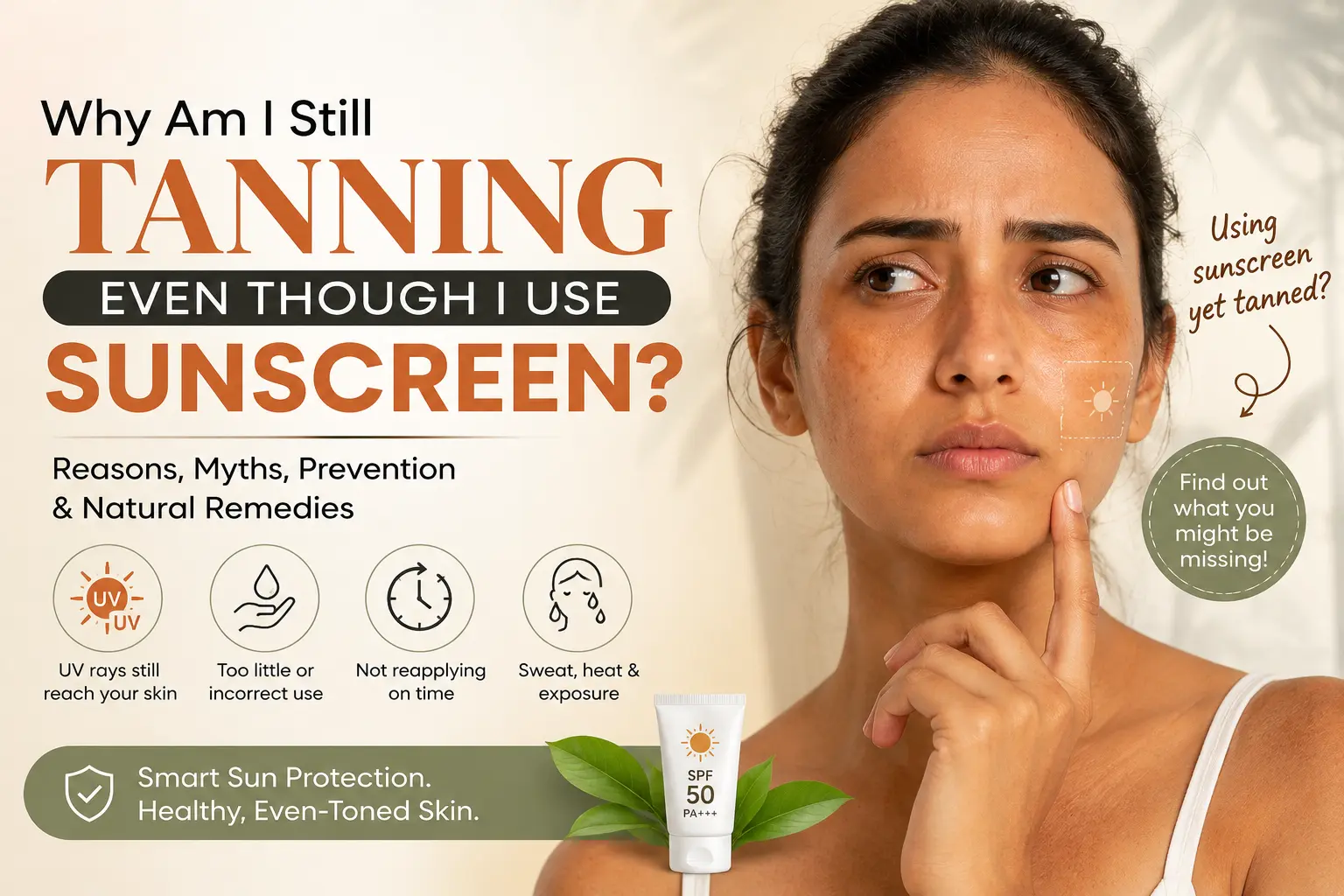
You bought the SPF 50. You apply it every morning. You even remember it on most days.
And yet, after a few weeks in the sun, your face looks darker, your arms are noticeably tanned, and that uneven skin tone you were trying to avoid is back.
So what went wrong?
Can you actually tan while wearing sunscreen?
Yes.
And that does not necessarily mean your sunscreen is useless.
The more interesting answer is that SPF does not mean zero sun exposure, and the way you apply sunscreen matters just as much as the number written on the bottle.
Let’s unpack what is really happening, why you may still be tanning despite using sunscreen, and what you can do about it without turning your skincare routine into a 12-step project.
What is a tan actually?
A tan is your skin responding to ultraviolet radiation.
When UV exposure reaches the skin, it can trigger increased production of melanin, the pigment responsible for skin colour. The extra melanin absorbs some of that radiation and makes the skin appear darker.
That darker colour may look harmless, but tanning is a response to skin injury from UV exposure, not a sign that your skin is becoming healthier.
This is also why a tan does not simply disappear after one shower. Your skin has already responded to the exposure.
For a deeper explanation of how tanning develops and how to deal with existing tan, read our Ultimate De-Tanning Guide.
Why am I still tanning even though I use sunscreen?
There are several possible reasons.
1. You are probably using less sunscreen than you think
This is one of the biggest reasons.
A sunscreen cannot perform as well as the SPF on its label if you apply only a thin layer.
Dermatologists commonly recommend applying enough sunscreen to adequately cover exposed skin. The American Academy of Dermatology recommendsroughly 1 ounce (that's roughly 28 grams) for the exposed areas of an adult's body and about a teaspoon for the face, although exact amounts vary by person and the area being covered.
In everyday language:
A tiny pea-sized dot is unlikely to give you the protection you expect from SPF 50.
For the face, neck and exposed areas, many people find the two-finger method easier to follow than guessing the amount.
And remember the places people forget:
- Ears
- Neck
- Hairline
- Jawline
- Around the eyes
- Hands
- Feet
Those forgotten areas are often exactly where people notice tanning later.
2. SPF 50 does not mean 100% protection
This is a very common misunderstanding.
SPF mainly tells you about a sunscreen's protection against UVB, the type of UV radiation strongly associated with sunburn.
Broad-spectrum sunscreen also protects against UVA, which penetrates deeper and contributes to premature skin ageing and pigmentation.
But sunscreen is not an invisible wall between your skin and the sun.
Some UV radiation can still reach your skin. That means using sunscreen can greatly reduce UV exposure without guaranteeing that you will never develop any tanning or pigmentation.
Think of sunscreen as protection, not permission to stay in direct sunlight indefinitely.
3. You put it on once and forget about it
This is probably the biggest practical mistake.
You apply sunscreen at 8:30 AM. Then you commute. Then you walk outside for lunch. Then you sweat. Then you spend another hour outdoors.
Your sunscreen has been through an entire working day while you have done nothing to replace it.
The American Academy of Dermatology recommends reapplying sunscreen approximately every two hours when you are outdoors, and sooner after swimming or heavy sweating.
You do not necessarily need to reapply every two hours if you are sitting indoors all day with minimal sun exposure.
But if you are outside for long periods, reapplication matters.
4. Sweat can change the equation
India’s heat and humidity make sunscreen use particularly tricky.
You can apply sunscreen correctly in the morning and still spend the next few hours sweating, wiping your face, touching your skin or using a handkerchief.
That means the layer you carefully applied may not remain as intact as you think. This is especially relevant during summer, travel, workouts and humid weather.
Our guide on how changing weather can affect your skincovers why your routine often needs to change as the weather changes.
5. Your sunscreen may not be the right fit for your actual day
A sunscreen can look excellent on paper and still be a poor choice for your lifestyle.
Ask yourself:
Am I outdoors for long periods?
Do I sweat a lot?
Do I commute on a bike?
Do I spend time near water?
Do I reapply?
If your daily life includes heat, sweating and prolonged outdoor exposure, you need to think beyond the SPF number.
Look for broad-spectrum protection, and when you are spending substantial time outside, consider water-resistant options where appropriate.
6. You may be dealing with more than UVB
Most people hear "sun damage" and immediately think about UV rays.
But sunlight also contains visible light, and visible light can contribute to skin darkening and hyperpigmentation, particularly in people with darker skin tones.
This matters if your main concern is not just a temporary tan but dark spots, uneven pigmentation or melasma.
For people concerned about visible-light-related pigmentation, dermatologists may recommend a tinted sunscreen containing iron oxides in addition to broad-spectrum SPF.
So there is a difference between asking: "Why did I get darker after being outside?"
and asking: "Why do my pigmentation and dark spots keep getting worse?"
The second question may need a more targeted approach.
For a deeper look at pigmentation, read our guide on pigmentation, its causes and treatment.
7. You are applying sunscreen too late
Sunscreen is not something you should remember only after stepping into the sun.
The AAD recommends applying sunscreen before going outdoors, with about 15 minutes allowing the product to settle and provide protection as directed.
A Walk outside → remembering sunscreen → applying it
is not the same as Applying sunscreen → giving it time → going outside
That small habit can make a difference.
8. You protect your face but forget the rest of your body
This one is incredibly common. Your face gets SPF, but your arms, hands, and neck gets forgotten. Then you wonder why your face and body no longer match.
Sun protection should cover all exposed skin, not just the parts you are most worried about. This is also why a tan-removal routine needs to extend beyond facial skincare.
Can sunscreen prevent tanning completely?
No.
A good sunscreen can significantly reduce UV exposure, but there is no sunscreen that guarantees you will never tan.
Your results depend on several factors:
- How much sunscreen you use
- Whether it is broad-spectrum
- How often you reapply
- How much time you spend outdoors
- Sweat and water exposure
- Whether you use other forms of sun protection
- Your individual skin tone and response to sunlight
Sunglasses, sleeves, shade and avoiding unnecessary prolonged direct sun exposure can all reduce your overall exposure.
What if I am already tanned?
This is where people often make the situation worse. They see tanning and immediately reach for an aggressive scrub, then a strong exfoliating acid, then another "de-tan" mask. And now the skin is irritated on top of being tanned.
More friction does not automatically mean faster results.
Gentle exfoliation can help remove dead surface cells and improve the appearance and texture of skin, but over-exfoliation can irritate the skin. The AAD also advises against exfoliating sunburned or damaged skin.
If your skin is red, burning, peeling or sore after sun exposure, focus on calming and moisturising it first.
Deal with the tan once the skin has settled.
Natural home remedies for tanned skin
There is no kitchen ingredient that can magically erase a tan overnight. And some of the internet's most popular "de-tan hacks" can actually irritate your skin.
Lemon juice, for example, is not a good idea for trying to lighten tanned skin. Likewise, harsh scrubbing can leave irritated skin looking even more uneven.
But there are a few gentle home options that can help soothe the skin and support a more comfortable skin-care routine.
1. Oatmeal and water
Finely ground oats can be mixed with water into a simple paste and applied gently for around 10 to 15 minutes before rinsing.
Colloidal oatmeal is known for its soothing and moisturising properties and can help calm mild irritation.
This is better thought of as a soothing treatment, not a tan-removal miracle.
2. Cool compress
If your skin feels hot after being outdoors, a clean, cool, damp cloth can be useful. A cool compress can help calm uncomfortable, irritated skin.
Just avoid placing ice directly on the skin.
3. Plain aloe vera for comfort
Aloe vera is commonly used to soothe skin after sun exposure.
But remember, Aloe vera is not sunscreen, and it does not stop tanning.
Research has not shown aloe vera cream to provide reliable protection against suntan or to bleach away a tan.
Use it because it may feel soothing, not because you think it might help remove tan.
What about Ubtan?
Ubtan has been part of Indian skincare traditions for generations, usually involving combinations of ingredients such as turmeric, gram flour, sandalwood and other botanicals.
A gentle ubtan can be a nice ritual when your goal is to cleanse and lightly exfoliate the skin.
At B-Aesthetico, our Rituals Renewed Ubtanis designed around this idea of combining a familiar ritual with a more convenient modern formulation.
Still, no ubtan can replace daily sunscreen.
Should you exfoliate a tan?
Gentle exfoliation can remove some dead surface cells, making skin feel smoother and look more even, but it cannot remove the UV exposure that has already occurred.
For exposed body areas that have become rough and dull, a dedicated body exfoliant can fit nicely into a weekly routine.
Our De-Tan Body Polisheris designed for gentle body exfoliation and contains ingredients such as aloe vera, glycerin, walnut shell powder, carrot seed extract, liquorice and turmeric.
The reason to choose a product like this is not because it promises to "erase" the tan.
It is because a consistent, controlled exfoliation step is easier to use regularly than trying a different DIY scrub every weekend.
Morning
1. Cleanse
Use a gentle cleanser that leaves your skin comfortable rather than tight.
For example, you can pair your routine with a gentle product such as our Creamy Cleanser.
2. Treat your skin concern if needed
This might mean a serum for pigmentation, uneven tone, dehydration or another specific concern.
The important thing is not to stack random actives simply because they are trending.
Our approach is explained in more detail in Skinimalism: Why More Skincare Isn't Always Better.
3. Apply enough broad-spectrum sunscreen
Choose at least SPF 30, ideally one that fits your skin type and daily routine. Apply it before going outdoors and reapply during prolonged outdoor exposure.
For everyday protection, you can explore our Skin Saver SPF 50 Cream.
During the day
If you are outdoors for an extended period:
Reapply.
And don't forget that sunscreen is only one part of sun protection. Use shade, clothing, hats and sunglasses where practical.
At night
Cleanse your skin properly. Moisturise. Keep your routine sensible.
You do not need to attack your skin every night because you noticed a little tanning. Your skin needs consistency more than punishment.
How long does it take for a tan to fade?
A mild tan may gradually become less noticeable over several weeks, while deeper or repeated tanning can take much longer.
How quickly it fades depends on the depth of pigmentation, continued sun exposure, your individual skin response and how consistent you are with your routine.
This is why the best de-tanning routine has two parts:
Deal with the existing tan.
Prevent new tanning.
Doing only the first is like mopping the floor while the tap is still running.
What not to do when trying to remove tan
Avoid the temptation to make your routine more aggressive just because you want faster results.
Do not scrub until your skin is red
Redness is irritation, not proof that the product is working.
Do not exfoliate sunburned skin
Let damaged skin recover first.
Do not layer multiple strong exfoliants
More acids, more scrubs and more masks do not automatically mean faster de-tanning.
Do not stop sunscreen while treating a tan
If UV exposure continues, you are constantly adding to the problem.
Frequently Asked Questions
Can you still tan while wearing SPF 50?
Yes.SPF 50 significantly reduces UVB exposure, but it does not create a zero-UV environment. Applying too little sunscreen, failing to reapply and spending long periods outdoors can all contribute to tanning.
For everyday higher-SPF protection, see B-Aesthetico Skin Saver SPF 50.
Why am I getting darker even though I use sunscreen?
Check the basics first: how much you apply, whether you cover exposed areas, whether you reapply, how much time you spend outside and whether you sweat heavily.
If what you are noticing is persistent uneven pigmentation rather than a general tan, read our article on Pigmentation Causes, Effects on Skin & Best Treatment for Clear Skin.
Does SPF 50 prevent tanning?
Not completely.
SPF 50 can reduce UVB exposure, but it does not guarantee that your skin will never tan.
That is why application technique, reapplication and overall sun protection still matter.
Can you tan with sunscreen?
Yes.
Wearing sunscreen is still important, but sunscreen should be thought of as reducing exposure rather than eliminating it completely.
Why do I tan even with SPF 50?
Common reasons include under-application, lack of reapplication, sweat and water exposure, prolonged direct sunlight and inconsistent coverage.
If you also have pigmentation or dark spots, our pigmentation guideexplains why tanning and pigmentation are not always the same problem.
How do I remove tan naturally at home?
Gentle options such as oatmeal can help soothe the skin, while sensible exfoliation may improve the appearance of dull surface skin over time.
Home remedies should not be expected to erase a tan overnight.
Our Ultimate De-Tanning Guidecovers realistic approaches in more detail.
Is Ubtan good for tanning?
A gentle ubtan can be part of a cleansing and light-exfoliation routine, but it is not a miracle tan remover.
Our Rituals Renewed Ubtancan fit into that kind of ritual, but sunscreen remains the more important step for preventing further tanning.
How often should I reapply sunscreen?
For prolonged outdoor exposure, the American Academy of Dermatology generally recommends reapplying around every two hours and sooner after swimming or heavy sweating.
If you prefer a simpler morning routine, our Moisturizer with SPF 30combines moisturising with sun protection, while Skin Saver SPF 50offers a higher-SPF option.
Should I scrub my face to remove tan?
Not aggressively.
Gentle exfoliation may help improve texture and remove dead surface cells, but harsh scrubbing can irritate the skin.
For body care, the De-Tan Body Polisheris designed specifically for body exfoliation.
Can sun exposure make your skin age faster?
Repeated UV exposure contributes to photoageing and can worsen pigmentation and visible skin changes over time.
That is one reason daily sun protection is relevant to anti-ageing too. You can read more in Anti-Aging Treatments That Actually Work.
Is sunscreen enough to protect skin from the sun?
Sunscreen is important, but it works best as part of a broader sun-protection routine that also includes shade, clothing, hats, sunglasses and avoiding unnecessary prolonged exposure.
For a broader skincare routine, see our Ultimate Guide to Skincare for Every Skin Type.
What should I use if my skin gets irritated easily?
Keep your routine simple and avoid piling multiple strong actives or harsh exfoliants on already irritated skin.
Our guide to Skincare Practices for Sensitive Skincovers the basics in more detail.
Latest Posts



Related Articles
What Really Is SPF?
Have you ever looked at your sunscreen and seen the big, bold text saying, “SPF 50”?...
How Humidity Affects Your Skin & Hair: The Complete Monsoon Guide
Why does your face suddenly look oilier in the monsoon? Why does your scalp feel greasy...

How to Remove Tan Effectively: The Ultimate De-Tanning Guide (2026)
Sun exposure can leave your skin looking darker, uneven, and dull. Learn what causes tanning, how...